Background
Many of us are familiar with Sentinel 2 imagery. It is currently the primary imagery source used in many agricultural applications. Sentinel 2 is controlled by the European Space Agency (ESA), and the data is made freely available. It has a 10m spatial resolution with a 5-day revisit cycle to any point on earth.
PlanetScope is a commercial imagery provider that images the whole earth almost daily. It has a 3 to 5m spatial resolution.
Last season, I decided to experiment with PlanetScope imagery on one paddock to compare it to the freely available Sentinel 2 imagery.
Crop Details
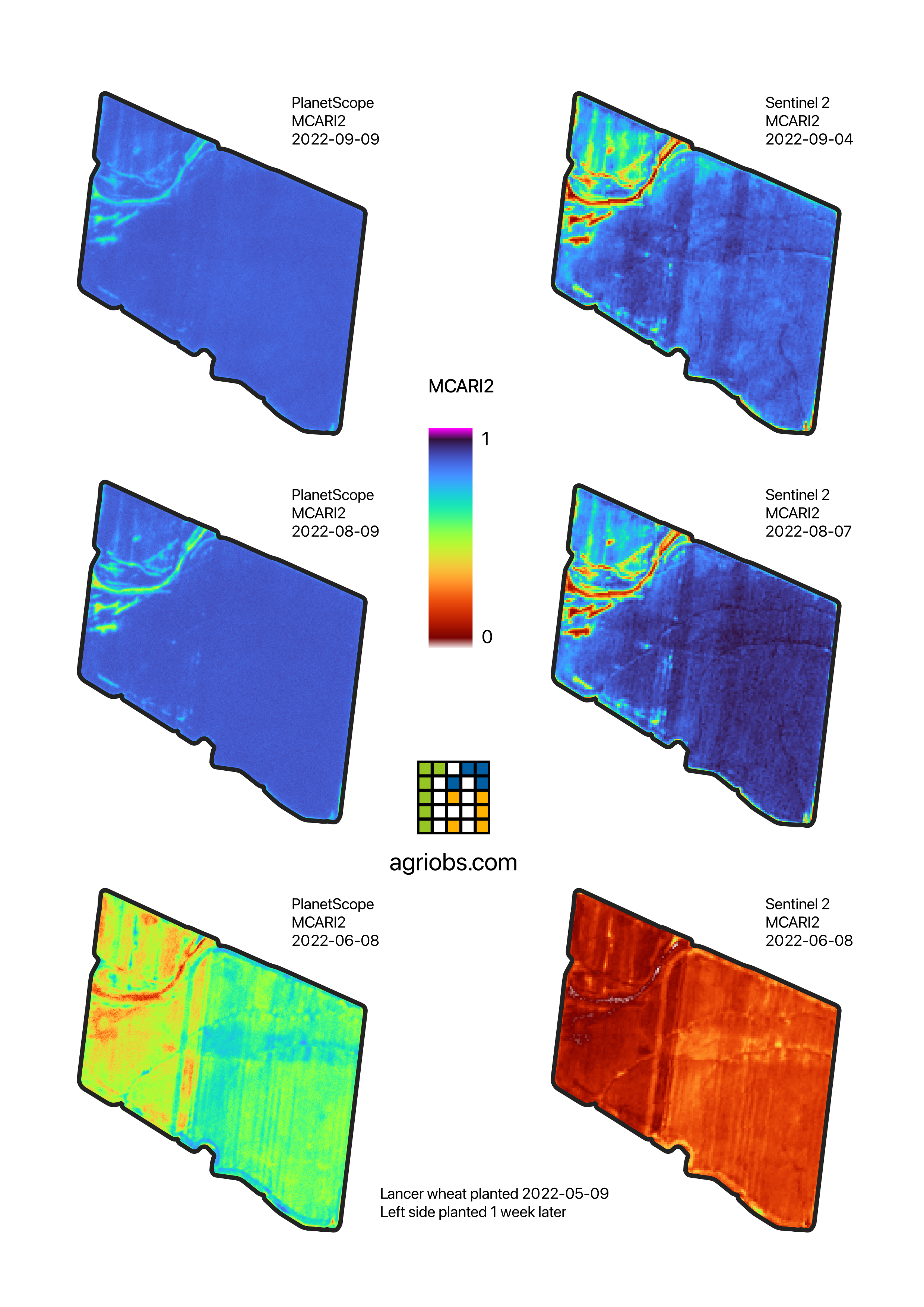
The crop planted was Lancer wheat, which went in on 9 May 2022. As you will see in the imagery, this crop had a few things going on:
- Two-stage planting due to a rain event
- Waterlogging through the western part of the field
- Urea fertiliser rates changed through the middle of the field
- Phalaris weeds choking out wheat in the northwestern corner – controlled in June
All this makes the data interesting to examine. The crop's average yield was 4.75t/ha with 10.6% protein.
Imagery
Data Discussion
It is evident in both the August and September acquisitions that the PlanetScope imagery does not detect any variability in the crop for the entire eastern half of the paddock. In the Sentinel 2 imagery, the north-south running fertiliser rate affected strip and contour banks are detectable.
Furthermore, in the August imagery, the Sentinel 2 image does a much better job at exposing the variability from all the issues on the east side of the field.
The early June PlanetScope image looks more sensible, but it’s important to note the crop had only been established for 4 weeks.
PlanetScope imagery boasts a higher spatial resolution, which is discernible and useful in the June comparison. But this is where any quality advantage ends. The 3 to 5m spatial resolution provides no real benefit in understanding the severity of the issues at hand compared to the Sentinel 2's 10m.
The real advantage of PlanetScope is its temporal resolution. You can’t beat daily imagery. For some farms, particularly those unable to reliably get Sentinel 2 imagery due to consistent cloud cover, PlanetScope may be necessary. However, if you require imagery late in the season, PlanetScope may not be useful if it becomes saturated.
Data Processing and Cost
Modified Chlorophyll Absorption Reflectance Index 2 (MCARI2) was calculated from both the Sentinel 2 and PlanetScope data. MCARI2 generally performs well at not saturating in high biomass situations and is my usual go-to instead of NDVI. The output image shows three different dates compared using a fixed color scale across both imagery types and all dates.
PlanetScope imagery is intriguing because it captures and archives imagery of the whole earth continuously. This means you always have the option to go back in time with Planet, with no tasking required.
I purchased the PlanetScope imagery through Sentinel Hub. Sentinel Hub costs EUR30/month for a non-commercial license, and the PlanetScope imagery cost EUR500 (EUR2.5/ha or AUD$3.85/ha or US$2.70/ha). The imagery is provided on a subscription basis, with all imagery over a 12-month period delivered to a cloud storage bucket accessible through Sentinel Hub.
Once in Sentinel Hub, you can access it on their EO Explorer or feed it through to GIS software like QGIS or ArcGIS as WMTS or similar. There are technical aspects to consuming imagery this way instead of through a specialized app, but it offers more freedom to process the imagery as desired. Sentinel 2 imagery is accessed the same way, but there is no cost for the imagery.
Conclusion
In conclusion, these datasets are sourced from very different hardware systems, leading to vastly different outcomes. I think PlanetScope is an appropriate solution in high cloud areas for early assessments, such as examining high N test strips. However, beyond a month or two into the growing season for cereal crops, PlanetScope is likely to saturate in a positive season. I would not recommend spending extra money on PlanetScope if you have ample Sentinel 2 imagery available.